Ahmadinejad unveils Iran's newest fighter jet


Ahmadinejad unveils Iran's newest fighter jet


Iran on Saturday unveiled its newest combat jet, a domestically manufactured fighter-bomber that military officials claim can evade radar.
President Mahmoud Ahmadinejad said in a ceremony broadcast on state TV that building the Qaher F-313, or Dominant F-313, shows Iran's will to "conquer scientific peaks."
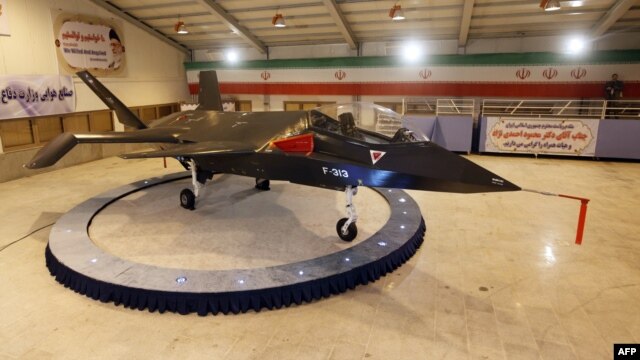


The Qaher is one of several aircraft designs the Iranian military has rolled out since 2007. Tehran has repeatedly claimed to have developed advanced military technologies in recent years, but its claims cannot be independently verified because the country does not release technical details of its arsenals.
The Islamic republic launched a self-sufficient military program in the 1980s to compensate for a Western weapons embargo that banned export of military technology and equipment to Iran. Since 1992, Iran has produced its own tanks, armored personnel carriers, missiles, torpedoes, drones and fighter planes.
"Qaher is a fully indigenous aircraft designed and built by our aerospace experts. This is a radar-evading plane that can fly at low altitude, carry weapons, engage enemy aircrafts and land at short airstrips," Defense Minister Ahmad Vahidi said.
Vahidi said advanced materials were used to manufacture the body of the aircraft, making it Iran's best stealth plane.
However, some reports suggest that Iran's program relies on equipment supplied by major international defense contractors and that it incorporates parts made abroad or uses outside engineered technologies in its domestic designs.
Still photos of the Qaher released by the official IRNA news agency and pictures on state TV showed a single-seat jet. They described it as a fighter-bomber that can combat other aircraft and ground targets.
Iran's English-language state Press TV said Qaher was similar to the American-made F/A-18, an advanced fighter capable of dogfighting as well as penetrating enemy air defenses to strike ground targets.
But Hasan Parvaneh, an official in charge of the project, said the physical design of the Iranian plane was unique and bore no resemblance to any foreign fighter jet.
"Development depends on our will. If we don't have a will, no one can take us there," Ahmadinejad told the inauguration ceremony in Tehran. "Once we imported cars and assembled them here. Now, we are at a point where we can design, build and get planes in the air."
Ahmadinejad said Qaher was built for deterrence.
"It's not for expansionism. It's for deterrence," he said, claiming the aircraft was among the most advanced fighter jets in the world.
In 2007, Iran unveiled what it said was its first domestically manufactured fighter jet, called Azarakhsh or Lightning. In the same year, it claimed that Azarakhsh had reached industrial production stage.
Saeqeh, or Thunder, was a follow-up aircraft derived from Azarakhsh. Iran unveiled its first squadron of Saeqeh fighter bombers in an air show in September 2010.


PHOTOS: First Ever India-China Naval Exercise

PHOTOS: First Ever India-China Naval Exercise


On completion of the four day visit to Shanghai, INS Shivalik and PLA(N) Ma'anshan conducted passage exercises comprising naval manouevers, communication exercises and cross deck helicopter landings.


Light Combat Helicopter Sea-level Trials SuccessfulLight Combat Helicopter Sea-level Trials SuccessfulLight Combat Helicopter Sea-level Trials Successful


Light Combat Helicopter Sea-level Trials Successful


Exclusive photos of the ongoing sea-level trials of the second prototype of India's Light Combat Helicopter (LCH) on the outskirts of the Chennai. Check out that sexy cockpit shot as the pilots near the East coast. The last photo, also taken from the LCH, shows the IAF chase Mi-8 from Yelahanka air force station that's flying with and observing/recording the LCH during the current round of sea-level trials. The trials will continue for another 7-9 days.


Agni II test

Agni II Test


India's First Embraer AEW&C On Indian Soil


India's indigenous Embraer AEW&C On Indian Soil


DRDO Statement: The first fully modified aircraft for India's indigenous Airborne Early Warning and Control System landed on Indian soil at CABS (Centre for Airborne Systems, Bangalore, a DRDO laboratory) at 22:10 hours at HAL airport, Wednesdat night. The aircraft and the flight crew was received by Dr Christopher Program Director and Dr K Tamil Mani, Chief Executive, CEMILAC. The acceptance of the Aircraft was completed over a period of 15 days at Embraer Facilities in Brazil,  by a team from CABS,  its work centres, CEMILAC, DGAQA & IAF. The Aircraft was flagged off from M/s Embraer, Brazil on 17 Aug 2012 at 1125 hours by Shri G Elangovan, Chief Controller R&D, Dr S Christopher, Programme Director, Mr K Tamil Mani, Chief Executive, CEMILAC and team members and was flown across multiple continents to arrive in India today.

The Aircraft ferried with several mission system external components of DRDO including the Active Electronically scanned Array Antenna with passive electronics fitted on the Aircraft. The arrival of this Aircraft marks the beginning of another phase of journey leading to the next major milestone of integration of the DRDO developed mission system, which will be followed by development flight trials in India beginning of 2013. It may be noted that this is the first Aircraft delivered by M/s Embraer for which the contract was signed in 2008. The next Aircraft is expected to arrive in December 2012.

India's New AW101 VVIP Merlin Lift Off

Iron Dome: A Missile Shield That Works


Iron Dome: A Missile Shield That Works


Military gear-heads like to boast about how this or that latest technology that they’re fond of – or that their company, or country, is pushing – is a “game-changer.”
The major-combat debut of Israel‘s Iron Dome missile-defense shield over the past several days may be one of the few that can legitimately make that claim.
It is destroying about 90% of the rockets and missiles that Hamas, the Palestinian political party governing Gaza, is firing into southern Israel, Israeli officials say.
One battery of Iron Dome anti-missile missiles downed 100% during a salvo, a senior Israeli official tells.
“We’ve got about a 90% success rate,” he says, proudly giddy. “This is unprecedented in history.” It’s also impossible to confirm, but the lack of Israeli casualties suggests Iron Dome is the most-effective, most-tested missile shield the world has ever seen.
“We keep tweaking it,” says the senior official, who declined to be identified. “In one of the recent exchanges, one of the batteries was 100% [successful]. That means, to me, that Iron Dome is capable of 100% [across the board] — I don’t think it was entirely a fluke.” He said he didn’t know how many missiles and interceptors were involved in the salvo; an Iron Dome battery typically consists of a radar unit and three launchers, each outfitted with 20 Tamir interceptor missiles.
The bottom line: the more rockets Hamas fires, it seems, the better at stopping them Iron Dome becomes.
They’re playing a game of aerial attrition: who will run out of missiles first?
The missile shield’s success came as Israel broadened its attacks on Hamas-related sites in Gaza over the weekend, launching air strikes against political sites – including the headquarters of the Hamas prime minister – as well as military targets.
“There’s no country on Earth that would tolerate missiles raining down on its citizens from outside its borders,” President Obama said Sunday in Thailand, his first destination on a three-stop, three-day tour of southeast Asia. “So we are fully supportive of Israel’s right to defend itself from missiles landing on people’s homes and workplaces and potentially killing civilians.”
Iron Dome impressed Defense Secretary Leon Panetta in August during a tour of a battery while he was in Israel. “Iron Dome has had a better than 80% success rate at hitting rockets fired from Gaza into Israeli population centers, and it has successfully intercepted more than 100 rockets,” he said shortly after he returned. “We can be proud of this system’s record of saving lives and preventing wider conflict in that region.”
As of Sunday, Hamas had fired close to 1,000 missiles and rockets into Israel. Iron Dome decided — by tracing their trajectory and likely impact points within seconds of launch — that about two-thirds didn’t pose a threat and let them fall harmlessly to Earth. It destroyed about 90% of the remaining 300 or so that threatened to land in populated areas, Israeli officials said.

The senior Israeli official says the system’s battle management software is sensitive enough to monitor the trajectory of incoming missiles. “It distinguishes whether it is going to hit downtown or an open field,” he says. “If it’s going to hit an open field we don’t shoot at it.”
That’s important because the interceptors cost up to $100,000 each. That’s pocket change – heck, pocket lint – to the U.S. military, but relatively costly to the Israeli government, especially compared to the incoming rockets, which “are basically free” to Hamas, the official says (they can cost less than $1,000).
Iron Dome “is actually a money-saver,” he adds. “Think if these rockets actually hit a neighborhood, in terms of the human costs, the wounded, the destruction of infrastructure would be much greater. So $100,000 is not that much to pay for a house that’s full of kids.”
Iron Dome was developed by Israel’s Rafael Advanced Defense Systems Ltd., and is expected to cost close to $1 billion by the time up to 15 batteries are bought (five are now deployed in southern Israel). The U.S. has pledged about $300 million to help fund the effort. Israel decided to build the system after the 2006 Second Lebanon War, when 4,000 Hezbollah rockets rained down on northern Israel, killing 44.
Iron Dome is designed to counter short-range missiles with a range of 70 kilometers or less – about 45 miles. Its prey includes crude Katyusha and Qassam rockets and Soviet-designed but built-in-Gaza Grads, with a range of up to 25 miles. The mobile system saw its first real-world test in April 2011, when it downed a Gaza-fired Grad in April 2011. Hamas said it had launched an Iranian-made Fajr-5 missile, with a range of up to 45 miles, toward Tel Aviv this past weekend, but Israel said they shot it down, too.
As of Sunday, 57 Palestinians had died in the Israeli counter-attacks, including 24 civilians, and more than 400 civilians have been wounded, according to Palestinian officials.
“We have had casualties,” the senior Israeli official concedes. “But the casualties we have had – the three killed – was not because of Iron Dome, but because the people didn’t listen to the siren – they thought they were out of range.”
The hype continues. But in this case, for a change, it might be warranted.